
When your child's first tooth pokes through, something remarkable begins. That tiny white edge marks the start of a dental development process that will unfold over the next two decades. Here's what many parents don't realize: the care those teeth receive during childhood shapes oral health for life.
Specialized pediatric dental care is dentistry designed specifically for growing mouths, from the moment that first tooth appears through the teenage years. It's not simply "regular dentistry for smaller families." The entire approach differs, from the size of the instruments to the way our team communicates with your child. At Kids Care Dental and Orthodontics, families find that specialized care makes all the difference.
Think about it this way. A pediatrician isn't just a doctor who happens to see kids. They've trained extensively to understand how young bodies grow, develop, and respond to illness differently than adults. Pediatric dentistry works the same way.
What Is the Scope of Pediatric Dental Care?
Pediatric dental care is a kid-focused branch of dentistry that covers prevention, restorative work, hospital and sedation services, and orthodontic monitoring from infancy through the teen years. Each area works together to protect growing smiles, and our practice approaches each one with kid-focused expertise that families simply can't find at a general practice.
Prevention sits at the foundation. Routine cleanings, fluoride treatments, dental sealants, and education about brushing and flossing all fall under this umbrella. The goal? Stopping problems before they start.
Restorative work addresses issues when they arise. Cavities happen, even in the most diligent families. Our pediatric specialists fill cavities, place crowns on damaged teeth, and perform gentle extractions when necessary. They use techniques adapted for kids' smaller mouths and developing structures.
Hospital and sedation dentistry helps kids who need extra support. Some kids feel a lot of nervousness at the dentist. Others need extensive work completed in one visit. Hospital and sedation dentistry options make treatment possible for these families.
What Are Primary Teeth, Mixed Dentition, and Permanent Teeth?
Your child's mouth goes through distinct phases. Understanding these helps explain why specialized care matters.
Primary teeth, often called baby teeth, typically start appearing around 6 months of age. By age 3, most kids have all 20 primary teeth. These teeth aren't just placeholders. They help your child chew, speak clearly, and guide permanent teeth into proper position.
Mixed dentition describes the period when your child has both baby teeth and permanent teeth. This typically runs from about age 6 to age 12. It's a dynamic time. Teeth are falling out, new ones are coming in, and the jaw is growing rapidly.
Permanent teeth begin emerging around age 6 with the first molars. The process continues through the early teenage years, with wisdom teeth potentially appearing in late adolescence.
Each phase presents unique considerations. A cavity in a baby tooth requires different treatment than one in a permanent tooth. Crowding during mixed dentition might resolve naturally, or it might signal the need for early orthodontic evaluation. Our team watches for these changes at every routine exam.
How Does Pediatric Dental Care Differ from Adult Dentistry?
Walk into a pediatric practice and you'll notice differences immediately. The waiting area might have toys, books, or games. Treatment rooms often feature colorful decorations and kid-sized furniture, creating a kid-friendly environment from the moment families step through the door.
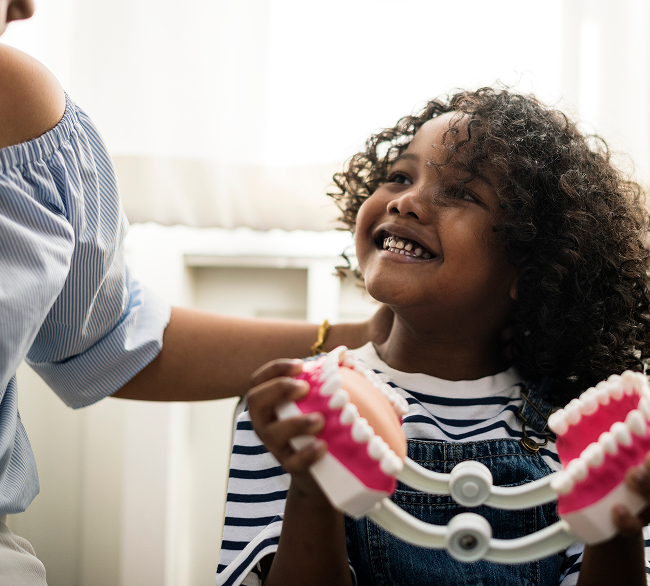
But the differences run much deeper than décor. Communication style adapts to each child's age and temperament. Our team uses simple language, demonstrates procedures on models or stuffed animals, and takes time to answer questions. A 3-year-old needs a different approach than a 12-year-old.
Tools and equipment are sized appropriately, with smaller instruments that fit comfortably in smaller mouths. X-ray sensors designed for kids reduce discomfort. Behavioral guidance helps kids feel comfortable through techniques like tell-show-do, where our team explains what will happen, shows the tools, then performs the procedure to reduce worry. Positive reinforcement builds confidence.
Developmental focus shapes every treatment decision. Our pediatric specialists consider how treatment will affect growing structures. Will this gentle extraction impact how permanent teeth come in? Is this bite issue something the child will grow out of, or does it need intervention? These questions guide every recommendation.
How Do You Manage Dental Worry in Kids?
Let's be honest. Many adults carry dental worry that started in childhood. A negative early experience can create lifelong unease around dental visits.
Our practice prioritizes positive experiences for every child. This isn't about making dentistry "fun" (though it can be). It's about helping kids feel safe, respected, and in control during every visit.
Strategies include gradual exposure for nervous kids, starting with simple visits before any treatment. Distraction techniques like ceiling-mounted TVs or music keep little minds occupied. Parent presence in the treatment room when appropriate offers reassurance. Nitrous oxide (laughing gas) helps kids who need mild relaxation. Verbal reassurance throughout procedures keeps kids feeling secure.
For kids with significant nervousness or special healthcare needs, hospital and sedation dentistry options provide safe, effective solutions. Our pediatric specialists are trained to determine when sedation might help and which type suits each child's situation.
According to the American Academy of Pediatric Dentistry, behavior guidance techniques help most kids receive dental care successfully without sedation. When sedation is needed, proper training and monitoring protocols keep kids safe.
How Does Pediatric Dental and Orthodontic Care Work for Kids in Plantation?
Pediatric dental and orthodontic care unfolds in stages from infancy through the teen years, including a first visit by age 1, routine exams every six months, an orthodontic evaluation by age 7, and treatment when needed. Understanding what to expect removes much of the mystery from dental visits.
What Happens at the First Dental Visit?
The American Academy of Pediatric Dentistry recommends kids see a dentist by age 1 or within six months of the first tooth appearing, whichever comes first. This surprises many parents. What could a dentist possibly do for a baby?
Quite a lot, actually. That first visit establishes a baseline. Our team examines your baby's gums, any teeth that have emerged, and the overall oral environment. We check for early signs of decay (yes, it can happen even in infants) and assess how the jaw is developing.
Just as importantly, the first visit introduces your child to the dental environment. A positive experience early on sets the stage for comfortable visits throughout childhood.
Parents receive guidance on cleaning baby teeth and gums, bottle and breastfeeding habits that affect oral health, pacifier use and thumb-sucking, when to expect new teeth, and fluoride recommendations.
What Does Routine Care Look Like?
After that initial visit, most kids benefit from routine exams every six months. A typical visit includes a professional cleaning that removes plaque and tartar that brushing misses. Even kids who brush well can have buildup in hard-to-reach areas.
Examination follows, with our team checking for cavities, gum health, bite development, and any concerns. We look at how teeth are coming in, whether spacing is appropriate, and how the jaw is growing. Fluoride treatment strengthens enamel and helps prevent decay, with professional fluoride applications more concentrated than toothpaste for added protection. X-rays, when indicated, reveal what's happening below the gumline. They show developing permanent teeth, detect cavities between teeth, and help identify potential orthodontic issues. Education wraps up the visit, with our team demonstrating proper brushing and flossing techniques, discussing diet choices that affect teeth, and answering your child's questions.
When Does Orthodontic Screening Matter Most?
The American Association of Orthodontists recommends kids have an orthodontic evaluation by age 7. This might seem early, especially if your child's teeth look fine. But there's solid reasoning behind this timing.
By age 7, enough permanent teeth have emerged to reveal potential issues. The first molars and incisors are typically in place, allowing our orthodontic team to assess how the upper and lower jaws relate to each other, whether there's adequate space for remaining permanent teeth, bite alignment (overbite, underbite, crossbite, open bite), and harmful habits like thumb-sucking that might affect development.
Many kids evaluated at 7 don't need immediate treatment. Our team might recommend monitoring growth and checking back in a year or two. For some kids, though, early intervention makes a significant difference.
Common Treatments for Growing Smiles
Despite the best prevention efforts, some kids need restorative treatment. Fillings repair cavities, and in baby teeth, tooth-colored composite fillings are often used. The procedure is typically quick, especially with proper behavioral guidance.
Crowns cover and protect teeth with significant damage or decay. Stainless steel crowns are common for baby teeth. They're durable and cost-effective, lasting until the tooth naturally falls out. Gentle extractions remove teeth that can't be saved or that are preventing proper development. Baby teeth sometimes need gentle extraction if they're severely decayed, infected, or blocking permanent teeth. Pulp therapy, similar to a root canal, treats infected tooth pulp. This can save a tooth that would otherwise need a gentle extraction. Space maintainers hold space when a baby tooth is lost early. Without a maintainer, surrounding teeth can drift into the gap, creating issues when the permanent tooth tries to come in.
What Are the Hospital and Sedation Dentistry Options?
Some kids need help beyond behavioral guidance. Hospital and sedation dentistry provides several options for families.
Nitrous oxide (laughing gas) offers mild relaxation. Your child remains awake and responsive but feels calm. The effects wear off within minutes after the mask is removed. Oral sedation uses medication taken by mouth to create deeper relaxation, and your child might feel drowsy and may not remember the procedure clearly. IV sedation provides deeper relaxation for more extensive procedures or kids with significant nervousness. General anesthesia (hospital dentistry) is reserved for complex cases, very young kids needing extensive treatment, or kids with special healthcare needs. This takes place in a hospital or surgical center setting with an anesthesiologist present.
Our pediatric specialists carefully evaluate each child to recommend the right level of sedation when needed. Safety protocols and monitoring ensure your child's wellbeing throughout.
What Are Phase One and Phase Two Orthodontics?
Orthodontic treatment often happens in two phases for kids.
Phase one treatment, sometimes called interceptive treatment, typically occurs between ages 7 and 10, while baby teeth are still present. The goal isn't necessarily straight teeth. Instead, phase one treatment addresses specific developmental issues: creating space for crowded permanent teeth, correcting crossbites that could affect jaw growth, reducing the severity of overbites or underbites, breaking harmful habits like thumb-sucking, and guiding jaw growth.
Phase one treatment usually lasts 12 to 18 months. After treatment, there's often a resting period while remaining permanent teeth come in.
Phase two treatment typically begins once most or all permanent teeth have erupted, usually in the early teenage years. This phase focuses on aligning all permanent teeth, refining the bite, and achieving improved appearance and function.
Phase two treatment might involve traditional braces and aligners or Spark aligners, depending on the case and family preference.
Not every child needs both phases. Some kids benefit from phase one treatment alone. Others don't need intervention until their permanent teeth are in. Some kids sail through childhood with perfectly aligned teeth, needing no orthodontic treatment at all.
How Do Pediatric Dentistry and Orthodontics Work Together?
One significant advantage of a practice offering both pediatric dentistry and orthodontics is coordination. When the same team handles your child's cleanings and orthodontic care, communication flows smoothly.
Our pediatric dental team monitors your child's development during routine exams. When we spot potential orthodontic concerns, we can discuss them with you and, when appropriate, arrange a free ortho consult. If your child gets braces and aligners, their orthodontic progress and dental health are managed together.
This integrated approach means fewer visits at different offices, consistent records, and a team that knows your child's complete dental history.
What Are the Key Benefits of Early Dental and Orthodontic Care for Kids in Plantation?
Starting dental care early and maintaining consistent visits throughout childhood delivers benefits that extend far beyond cavity prevention. Early specialized care provides prevention savings, early orthodontic detection, lifelong positive habits, support for development, long-term cost savings, and identification of airway concerns.
Why Choose Prevention Over Restoration?
The math is simple. Preventing a cavity costs far less than filling one. Preventing extensive decay costs far less than placing a crown or performing a gentle extraction.
But it's not just about money. Prevention means your child avoids discomfort, worry-inducing procedures, and time away from school or activities. A child who's never had a cavity has never experienced the stress of hearing "you need a filling."
Preventive care includes regular cleanings that remove plaque before it causes damage, fluoride treatments that strengthen enamel, dental sealants that protect vulnerable chewing surfaces, diet guidance that helps families make tooth-friendly choices, and brushing and flossing education that builds lifelong habits.
According to the Centers for Disease Control and Prevention, dental sealants can significantly reduce cavity risk in back teeth, where most cavities occur in kids. Yet many kids who could benefit from sealants don't have them.
Catching Orthodontic Issues Early
Certain orthodontic problems are easier to address during childhood, while the jaw is still growing. Early evaluation can identify several concerns that benefit from timely intervention.
Crossbites occur when upper teeth fit inside lower teeth. Left untreated, crossbites can cause asymmetric jaw growth. Early correction often takes advantage of natural growth to guide the jaw into proper alignment. Severe crowding might benefit from early intervention to create space for permanent teeth. Without treatment, crowded teeth can come in rotated, impacted, or severely misaligned. Protruding front teeth are more vulnerable to injury, and early treatment can reduce protrusion and protect teeth during active childhood years. Underbites, where the lower jaw extends beyond the upper, can worsen with growth. Early intervention might reduce the severity or eliminate the need for jaw surgery later. Harmful habits like thumb-sucking or tongue thrusting can affect dental development, and early intervention helps break these habits before they cause significant issues.
How Do Kids Build Positive Dental Habits?
Kids who have regular, positive dental experiences develop healthy attitudes toward oral care. They learn that dental visits are a normal part of life, not something to worry about.
This matters more than you might think. Studies consistently show that adults who avoid the dentist often skip needed care, leading to worse oral health outcomes. The pattern frequently traces back to negative childhood experiences.
When kids feel comfortable at the dentist, they're more likely to maintain regular routine exams as adults, seek care promptly when issues arise, follow through with recommended treatment, and pass positive attitudes to their own kids.
How Does Dental Care Support Overall Development?
Healthy teeth and proper bite alignment affect more than just smiles. They impact several areas of growth and wellbeing.
Speech development relies partly on proper tooth and jaw positioning. Missing teeth, severe crowding, or bite issues can affect how kids form certain sounds. Nutrition depends on effective chewing, and kids with painful cavities or missing teeth might avoid certain foods, potentially affecting their diet quality. Self-esteem often connects to appearance, and kids who are self-conscious about their teeth might smile less, cover their mouths, or avoid social situations. Facial development follows jaw growth patterns, and certain orthodontic issues, if left untreated, can affect how the face develops.
What Are the Long-Term Cost Savings?
Investing in preventive and early intervention care typically costs less than addressing issues after they've developed. A dental sealant costs a fraction of a filling. A filling costs less than a crown. Phase one treatment that prevents jaw surgery can save substantial costs. Preventing gum disease avoids expensive periodontal treatment later.
While the specific costs vary by location and insurance coverage, the principle holds: prevention and early intervention are almost always more economical than delayed treatment.
How Do Pediatric Specialists Catch Airway and Sleep Issues?
Our pediatric dental team is often the first to notice signs of airway issues or sleep-disordered breathing. During routine exams, we might observe enlarged tonsils or adenoids, a narrow palate, mouth breathing patterns, teeth grinding (bruxism), and specific bite patterns associated with airway issues.
These observations can prompt referrals to appropriate specialists, potentially identifying sleep apnea or other breathing issues that affect kids' health, behavior, and learning.
Pediatric Dentistry vs. General Dentistry: What's the Difference?
Pediatric dentists complete two to three years of additional residency focused exclusively on kids, work in kid-sized practices designed for young families, train extensively in behavior guidance, and develop specialized knowledge for growing mouths and kids with special healthcare needs. General dentists are licensed to treat all ages, but meaningful differences exist.
Some families wonder whether their child really needs a pediatric dentist. Technically, a general dentist can treat kids, but the depth of training and design of the space create a different experience.
| Feature | Pediatric Dentistry | General Dentistry |
|---|---|---|
| Extra Training | 2-3 year residency in kids' care | None beyond dental school |
| Office Environment | Kid-sized, kid-friendly | Adult-focused |
| Behavioral Expertise | Trained in kid-specific techniques | Limited kid-specific training |
| Sedation for Kids | Specialized training | Varies widely |
| Special Needs Care | Core part of training | Limited exposure |
How Much Training Do Pediatric Dentists Receive?
After completing dental school, pediatric dentists complete an additional two to three years of specialized residency training. This training focuses exclusively on treating infants, kids, adolescents, and kids with special healthcare needs.
During residency, pediatric dentists gain extensive experience in child development and psychology, behavior management techniques, hospital and sedation dentistry for kids, treatment of medically complex kids, special needs dentistry, dental trauma in kids, and growth and development of the face and jaws.
General dentists receive some pediatric training in dental school, but the depth and breadth don't compare to specialized residency training. At Kids Care Dental and Orthodontics, our team includes pediatric dentists like Dr. Jennifer Vargas, DDS, and Dr. Sara Daniel, DDS, who have completed advanced training in caring for growing smiles.
What Makes the Office Environment Different?
Our practice designs the space for kids. This goes beyond colorful paint and toys in the waiting room (though those help). Treatment rooms are sized appropriately for smaller kids. Equipment is designed for kids' mouths. Distraction options like ceiling-mounted screens keep little minds engaged. Safety features are appropriate for young kids. Scheduling accounts for kids' attention spans and energy levels.
The environment itself communicates to kids that this is a place designed for them, not a place where they're accommodated as an afterthought.
What Behavioral Expertise Do Pediatric Teams Bring?
Managing a wiggly 3-year-old or a nervous 8-year-old requires specific skills. Our pediatric specialists train extensively in behavior guidance techniques.
Tell-show-do involves explaining a procedure in child-friendly terms, demonstrating on a model or in the air, then performing the procedure. This reduces worry about the unknown. Positive reinforcement rewards cooperative behavior, building confidence for future visits. Voice control uses tone, volume, and pacing to communicate reassurance or redirect attention. Distraction redirects focus away from potentially worrisome aspects of treatment. Modeling allows kids to watch siblings or other kids receive care successfully.
These techniques help most kids receive care comfortably without sedation. When sedation is needed, our team has training and experience in safely sedating young kids.
Specialized Knowledge for Growing Smiles
Kids' dental needs differ from adults' in important ways. Primary teeth have different anatomy than permanent teeth. The enamel is thinner, and the nerve chamber is proportionally larger. Decay progresses differently, and treatment approaches must account for these differences.
Growth and development affect treatment decisions. Our pediatric specialists consider how today's treatment will affect tomorrow's development. Will this gentle extraction impact how permanent teeth come in? Is this bite issue something the child will grow out of? Anticipatory guidance helps parents prevent issues before they start. Our team advises on bottle and breastfeeding habits, pacifier use, thumb-sucking, diet, and other factors that affect developing teeth.
Why Does Special Needs Expertise Matter?
Kids with special healthcare needs often require modified approaches to dental care. Our pediatric specialists train specifically to treat kids with autism spectrum disorders, Down syndrome, cerebral palsy, intellectual disabilities, sensory processing disorders, medical conditions affecting dental care, and significant nervousness.
This training covers both clinical modifications and behavioral approaches that help these kids receive necessary care. Our team has extensive experience working with kids who have special healthcare needs. Family reviews frequently highlight our success with kids who struggled at other practices.
When Does General Dentistry Work Fine?
General dentistry can work well for older teens with simple, routine needs and no significant worry about dental visits. Kids who are calm, cooperative, free from special healthcare needs, and have no orthodontic concerns may do fine in a family practice. For younger kids, kids with developmental considerations, or families seeking integrated orthodontic monitoring, a pediatric specialist offers meaningful advantages.
Which Kids Benefit Most from Specialized Pediatric Care?
While every child can benefit from a pediatric dental team, certain kids see particularly strong outcomes with specialized care. Infants and toddlers having their first dental experiences benefit from a team trained to make those early visits gentle and reassuring. Kids with significant nervousness or past negative experiences often respond well to behavior guidance techniques and a kid-friendly environment.
Kids with special healthcare needs gain access to a team experienced in modified approaches and patient communication. Kids needing extensive treatment can take advantage of hospital and sedation dentistry options.